
Stress. Simply reading this word makes some people experience it. Then why would you care about reading a full article which mentions this term in every other sentence? Well, since the purpose of this article is to allow you to perceive stress from a different perspective, ideally making you understand it further and potentially helping you deal with it. Sounds like a good deal, right? So, buckle up and bear with me, for this might be a slightly long read, but hopefully a beneficial one!
With COVID-19 around, average stress levels worsened for the majority of people worldwide. In fact, staying away from friends, family members, and people in general brought lots of uncertainty to our daily life. Not only a new status-quo was imposed, but also breaking the rules put people's lives literally at risk. Beside loneliness and remote work, citizens worldwide have been worried about getting infected, losing their jobs, or even dying. All of these incidents increased stress levels among the global population, which was manifested by an upsurge in alcohol consumption, drug abuse and stress symptoms (1). But most importantly, this article is specifically dedicated to Lebanese citizens - my people - who have been enduring for quite long political and economic corruption, a hyperinflation, several murders, and a catastrophic explosion that destroyed our beloved capital Beirut, let along COVID-19. However, being a person who used to struggle with stress way before 2020, I learned to manage my stress despite all of the aforementioned (or else I would've gone nuts).
Before we jump to the solution - the "How?", let's first tackle the "Why" & "What".
So, what is Stress and why do we experience it?
All Human beings - as well as other mammals - undergo stress. It's manifested by a physical and psychological reaction, involving faster heart rate, rapid breathing, and a quivering voice. When this experience grows in severity and/or span, stress can turn into chronic stress and/or anxiety - and in such situations, you better talk with an expert.
But why? Why do our bodies behave as such when facing a stressful situation? What's even a stressful situation?

In fact, Homo Sapiens have been experiencing stress since forever. Our ancestors evolved this defense mechanism for survival. When our sensors perceive a life-threatening situation - a predator's attack for instance, stress is activated. Suppose you are a hunter-gatherer, circa 16'000 BC. By that time, agriculture had not yet been discovered. Your only source of nutrition was hunting wild animals and searching for fruits, competing with the wildest creatures out there. Luckily, you had the cognitive ability to manipulate fire, manufacture spears and cast spells - although I have mixed feeling about the effectiveness of the latter. When hunting a gazelle, you most probably were sharing this prey with a hungry pride of lions. Sometimes, you would find yourself outnumbered, and your toys would not scare the fearless giant cats. Your heart starts hopping, muscles tighten, and you feel your five senses upgraded: That's the "Fight-or-Flight" response. It's an extremely rapid mechanism that evaluates the critical signals perceived, to launch a defensive sequence permitting the victim to counter-react to the threat immediately, deciding to either fight it or flee it. Therefore, it's an instinctive trait, a bi-product of evolution and progression.
Now, to anticipate your question, the answer is yes. Modern people face stressful situations that are not necessarily life-threatening. I will tackle this topic just after explaining the physiological aspects of this response.
If you are not interested in the biological part, kindly skip the following section.
From a scientific perspective, the stress response is a work of art. It's a manifestation of fear, presumably, of death. It's an autonomic response, which means it is triggered automatically; yet it's still possible to manage it. We'll discuss this part in a bit. When a scary situation is detected from one of our sensory organs, a series of rapid actions is simulated in our brains. This sequence is complex and occurs in different sections of the brain, consisting mainly of the limbic system.
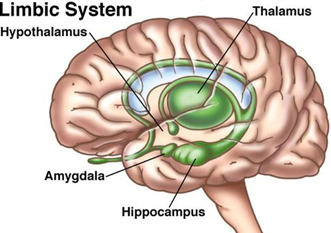
The limbic system is the part of the brain involved in processing emotions, memory, and behaviors, among which is the "Fight-or-Flight" response (2). It all starts in the Thalamus, which receives the signals of potential dangers (3). As the stress response is activated, a rapid chain reaction takes place. Back to the previous example, suppose that when you were about to throw your spear and kill the gazelle, you hear a noise and see a movement in the bushes next to you. Being alone, you immediately leave the prey and escape: That's the "low road". In this case, the Thalamus sends an alert directly to the Amygdala - another part of the limbic brain responsible for emotional processing, which will be further investigated. Now that you're far from the bushes, a simultaneous response is taking place: The "high road". This process is slower, since the message passes through the Hippocampus and Sensory Cortex before reaching the Amygdala, which explains why the process is slower. This route evaluates the severity of the situation and compares the signals to existing information stored as memory. What happens next is analogous to a simple closed-loop feedback control system: If the source of noise and movement was indeed a pride of lions, your primal brain proceeds with the stress response until you become safe. Should it be just the wind blowing, the stress response gets deactivated. Preferably, you should really wish it's the latter case. Anyway, the main focus here is on the Amygdala, which acts as the "Fight-or-Flight" switch. In reality, during a stressful incident, the Amygdala contacts the Hypothalamus, which acts as the control center, taking command of the body when in danger - or when you think you are (3, 4). During a stress response, your autonomic nervous system is stimulated, the part that controls involuntary actions, such as heartbeat, respiration, blood pressure, hormone secretion and what have you. This autonomic system consists of two components, the sympathetic nervous system, and the parasympathetic nervous system (4). The first is triggered under threat, activating the "Fight-or-Flight" response. A signal is sent to the adrenal glands which in turns pump Epinephrine (Adrenaline) and Norepinephrine (Noradrenaline) into your bloodstream. Accordingly, your pulse and blood pressure soar, your heart starts pumping blood rich in nutrients and oxygen to all of your vital organs (3, 4). You start breathing faster to provide the excessive amount of oxygen needed, and glucose and fats are released from temporary storage sites. Your blood vessels and airways expand, facilitating blood and air flow. All of your senses sharpen, notably visual and auditory ones. This chain of actions occurs so quickly that you cannot perceive it. After the decline of the first shot of adrenaline, the Hypothalamus stimulates a network called HPA - Hypothalamus, Pituitary gland, and Adrenal Glands. This network ensures the sympathetic system is kept activated. Therefore, if the pride of lions is still in sight, the Hypothalamus releases CRH - Corticotropin-Releasing Hormone, which launches the release of another hormone called Adrenocorticotropic Hormone (ACTH) from the Pituitary gland. ACTH in turns simulates the Adrenal glands to release several hormones, namely cortisol (3, 4). Cortisol plays an important role in the stress response. It works like an alarm: when the body is at high alert, cortisol can alter or shut down some functions that get in the way of your stress response, such as your digestive, reproductive or immune system (5). As long as one lion is still around, the body stays alerted. When you're safe again, cortisol levels drop. Thus, after evaluating the situation and ensuring that danger ceased, the Amygdala orders the Hypothalamus to switch from the sympathetic to the parasympathetic nervous system. In this case, the "Fight-or-Flight" response is deactivated, and the "Rest-and-Digest" response takes command, calming down the body and regulating autonomic functions back to normal. It is notable to mention that during the stress response, you feel difficulty concentrating on small tasks and focus instead on the big picture (3). You have limited control over your conscious logical cognitive skills.
If you skipped the biological background, please continue from here.
Indeed, the "Fight-or-Flight" response is crucial for survival. Yet, our perception of danger wasn't altered through thousands of generations. Ironically, with all our modern cognitive super-abilities, we still fall victims of instincts that didn't adapt to our modular lifestyles which are changing at an exponential speed.
Now, let's go back to the 21st century. Suppose that, God forbids, you were driving recklessly and were about to have a car accident. The "Fight-or-Flight" response is activated, and in this case, it is viable. Should you be a good driver and well familiar with your car, it becomes part of your body; you have control over it. Therefore, enhanced eyesight, rapid reflex, improved awareness, and immunity to pain will arguably help you way better than staying calm and thinking consciously of all the possibilities you can try. You actually have no time to think or try. You need to rely on your autonomic defense response to survive. Luckily, all you endured was people swearing at you. The next day, you decide to drive slowly, but you missed the fact that in order to arrive to the office in time, you need to wake up earlier! You find yourself amid a traffic jam, late to work. Again, your stress response is activated. Yet, this time, the situation is way different. You start foreseeing not one, but a myriad of bad scenarios that might occur once you arrive. Surprisingly, while still stuck in traffic, each new forecast you picture becomes more detrimental than the previous one. "My boss may shout at me. No, (s)he will most probably subtract this working day from my paycheck. No, no, (s)he will fire me for sure!" Stress starts to build over and lasts all the way until your arrival. Additionally, you may become so frustrated that you'll cause yourself negative consequences that wouldn't have happened should you stayed calm. In the latter situation, the "Fight-or-Flight" mechanism proves its failure.

In fact, after the cognitive revolution, Homo Sapiens' technological development was extremely rapid compared to the tens of thousands of years during which natural selection was doing its magic. It actually remained in stagnation during the last 70'000 years or so - a relatively short time span. Moreover, with the modern Internet revolution and the future Transhumanist uprising, Homo Sapiens are putting end to Darwinism and are about to dictate their evolution. Hence, due to the rapid technological growth, we notice that our brains couldn't adapt instinctively to modern challenges effectively. The "Fight-or-Flight" response failed to stay efficient against contemporary hazards. The shivers, headaches, among other side effects, coupled with stresses becoming chronic are unbearable. Some situations do not require the full package of stress response and sometimes, none at all. To understand the reason behind this inefficiency, we need to investigate the marvelous intrinsic characteristic that distinguished us from all the fauna and flora, allowing us to dominate it: Fiction.
Fiction governs our daily choices. Our beliefs, thoughts, ideals, morals, traditions, and even preferences are the product of fiction. But most importantly, our perception of the world around us is largely dictated by abstract beliefs. Indeed, the ability to conceive fictitious ideas consists of the foundation of today's technological and behavioral progress; yet we sometimes confuse fictional threats with factual ones. The two most common instances where stress is activated when there is no physical hazard are perhaps Public Speaking and Exams. Communication experts would argue that the "Fight-or-Flight" response actually leverages your speech, allowing you to deliver a better presentation. Experienced instructors tend to also believe that stress during a final exam enhances your performance. I partially agree. However, we all know a person whose voice keeps quivering and body keeps shivering during a speech or exam, ending up with undesirable results. That's because the source of stress is a fictional one, which is confused by the Human brain as being lethal. Not only our brains foresee a potential of failure beforehand, but also it equates this possible distress with a physiological danger! We fear humiliation, bad grades, indifference, rejection, irritation, as well as the judgement from our entourage, all of which has a low probability of occurrence… and here's the punchline: none of these is extremely harmful or lethal. One way to visualize this unnecessary stress response is by referring to Daniel Goleman's "Amygdala Hijack" concept, explained in his book "Emotional Intelligence: Why It Can Matter More Than IQ". In brief, during non-lethal threats, the Thalamus tends to bypass the rational brain (Neocortex) and contacts directly the Amygdala, persuading it that an abstract situation is a lethal threat, inducing a strong emotional reaction (6).

Presumably, different approaches can be adopted to deal with the drawbacks of stress, but they all boil down to one simple principle: Self-Awareness. In fact, genuine professionals warn that in order to benefit from stress, you need first to become aware of it. We will now delve deeper into how Self-Awareness holds the key not only to deal with stress, but also to achieve sustainable Happiness.
Actually, I could've just skipped the whole 2500 words or so and immediately offered you the answer to how stress can be controlled effectively. But unfortunately, that's not how things work. To be able to find solutions to modern challenges, you need first to become aware of the problem and well understand it. Thus, now that you're aware of stress and understand what activates it, you will easily be able to control it. Remember that in this article, we're dealing with stress, not extreme anxiety nor chronic stress.
Self-Awareness, in a nutshell, is being aware of one's thoughts, feelings, behaviors, and whatnot. Theoretically, it's simple to achieve. In practice, it takes lots of training. In fact, it's not a coincidence that experts recommend introducing healthy practices, such as meditation, yoga, or tai chi, to achieve a calm and balanced life. Extensive research found that meditation and mindfulness actually help coping with stress (7, 8). Practicing breathing exercises calms emotions and helps switching to the parasympathetic nervous system. Moreover, being mindful allows you to be aware of your emotions and fathom them, eliminating the fictional triggers that cause stress (7). Furthermore, mindfulness helps delaying the stress response, and that's very powerful (8). When you're mindful - present in the moment - you are fully aware of your strengths and weaknesses, your thoughts and beliefs. Therefore, you prevent the Amygdala from visualizing fictional threats as lethal ones, allowing your rational brain to respond. When you're self-aware of your strengths and weaknesses, you're automatically more confident. You trust your skills and are immune to negative judgement. Delivering a speech and undergoing an exam becomes a piece of cake: what's the worse that can happen? You're already well prepared for it. The "Fight-or-Flight" response becomes inefficient, unnecessary, obsolete. From a personal experience, I've conducted several exams and interviews (two of which were with famous figures) in the past months, without even having my heart quiver - a great progress for someone who used to overstress during any uncertainty. Actually, I had an incident a couple of months ago, during an important exam where I was already extremely short on time. I had to go with the guy who was monitoring the exam so he can switch my phone's alarm off, respecting my privacy - cool. Well, this cost me around two minutes of additional time wasted. Immediately, my stress response was activated, but I was well trained for this situation. Few breathing exercises in less than one minute, and I was back to the parasympathetic mode. Of course, I aced the exam. Though, meditation and mindfulness do not help slowing heartbeat and stabilizing the stress response by chance. Latest research found that mindfulness practices actually reduce the Amygdala's activity and size (9, 10, 11, 12). Findings concluded that mindfulness induces neuro-plastic changes in the cortico-limbic circuits responsible for the "Fight-or-Flight" mechanism (11). Actually, not only does the Amygdala shrink after practicing mindfulness for long, but the connections between the Amygdala and the Pre-frontal Cortex are also strengthened (9). This explains why being mindful eliminates the need for a stress response when no physical danger is in range. These findings were also visualized using fMRI, comparing people's Amygdala with and without weeks of mindfulness practices (10), hopefully paving the way for better understanding of chronic stress, depression, and anxiety.

After this overview about stress, I hope you're now aware of the stress response, why and when we need it, and how to control it. I also hope you start practicing mindfulness exercises more often.
A more creative and meticulous take on stress will be performed hopefully in a bigger work. If you're good at pattern recognition and follow my activity regularly, you may have noticed the pattern in all my previous articles as well as this one, constituting snitches of a potentially larger project.
"It takes me hours to craft minutes-worth of words which will hopefully inspire you for days, months, or years!" - Elio Gereige
References:
- https://www.mayoclinic.org/diseases-conditions/coronavirus/in-depth/mental-health-covid-19/art-20482731
- https://qbi.uq.edu.au/brain/brain-anatomy/limbic-system
- https://science.howstuffworks.com/life/inside-the-mind/emotions/fear1.htm
- https://www.health.harvard.edu/staying-healthy/understanding-the-stress-response
- https://www.webmd.com/a-to-z-guides/what-is-cortisol
- https://psychology.wikia.org/wiki/Amygdala_hijack
- https://www.mindful.org/how-to-manage-stress-with-mindfulness-and-meditation/
- https://www.mindful.org/9-ways-mindfulness-reduces-stress/
- https://pubmed.ncbi.nlm.nih.gov/31448928/
- https://www.mindful.org/how-the-brain-changes-when-you-meditate/
- https://pubmed.ncbi.nlm.nih.gov/23717632/
Comments