With Covid19, the deadly virus that's affecting millions of lives around the globe, shaping our lifestyles and behaviors day after day, the extraordinary ability of Humans to adapt quickly and effectively is the big thing to consider discussing.
By nature, we, Humans, tend to adapt to every situation we get into. Our brain's fantastic capacity to adjust to unprecedented changes is another proof of the biological adaptivity and environmental induced DNA modifications. However, my topic for today is not about epigenetics nor human biological evolution and mutations. Instead, the fantastic way today's workers are completing their jobs from home, students are doing distant-learning and friends/families are telecommunicating, is thanks to the relatively strong digital infrastructure we developed.
With the invention of the telephone back in the 19th century, engineers and inventors redefined human-to-human communication. Yet, physical presence was still needed in every major task, even after the Internet revolution– until today.
I'm sure you're thinking now about web conferencing platforms, that most of you are using to manage your education, projects or work. Indeed, that's one aspect of how this pandemic reshaped communication. Most traditional human actions that required physical presence in the past, are being managed via web conferencing platforms (WebEx, Zoom, Teams, Meet, you name it), and to your surprise, efficiently! For instance, Twitter staffs are now allowed to work from home forever, which proves that human presence, in most of the jobs and activities, may not actually be needed after all.
Nevertheless, tech pioneers look beyond those traditional platforms. That's why, I'll invite you now to broaden your minds and explore with me the future of human interaction and communication.
Indeed, Tech Giants like Google and so are shifting all their focus on providing (and for sure competing on) the ease of virtual communication to facilitate people's daily lives; a point that proves again the Human ingenuity when it comes to adaptation. However, if you skip the tech news, you may have missed the soaring breakthroughs in Virtual Reality, or what most people simply refer to as VR.
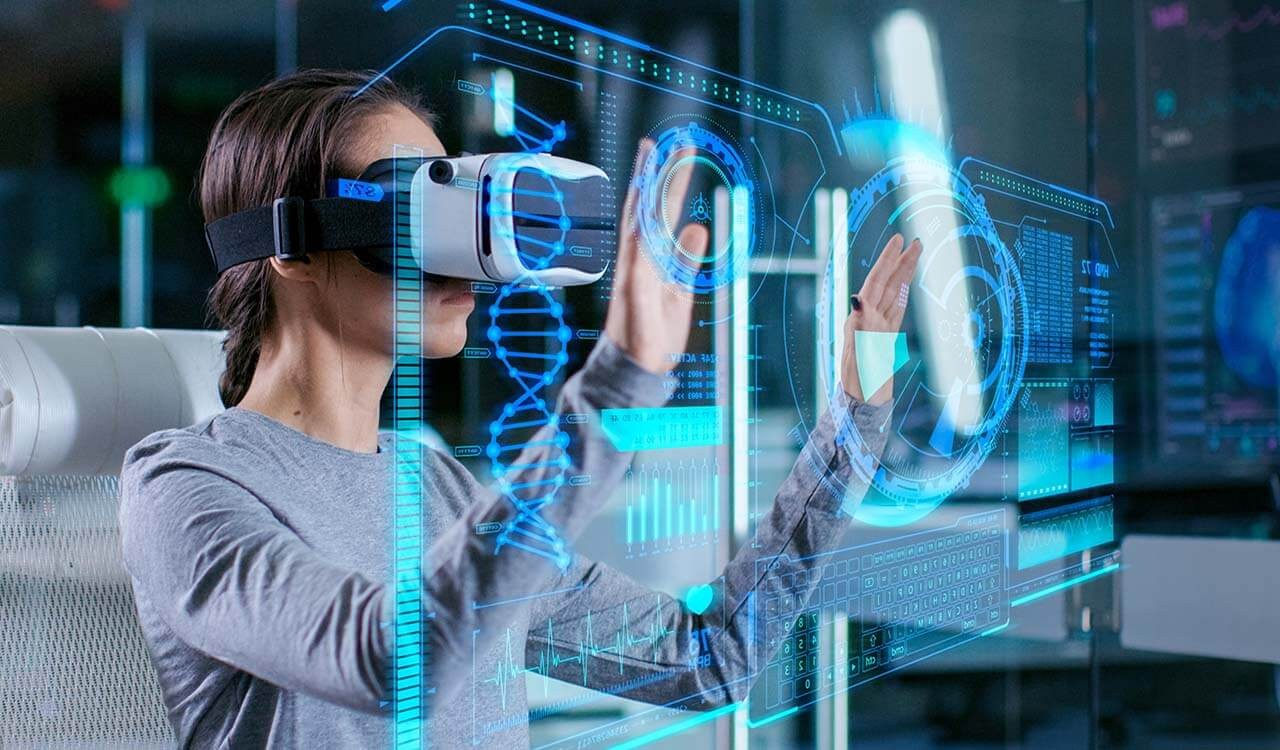
Virtual Reality, as the name implies, is the use of computerized gadgets to simulate events in an artificially crafted environment. You may be familiar with VR headsets used in gaming, but you'll be astonished to know that today's VR, as far as I know, is reinventing medical operations, military trainings, even tourism, research, and hence human interaction and communication, simulating all relevant human senses, from vision to hearing and even touch. To maximize its potential, imagine it being implemented along with Augmented Reality (AR), or Mixed Reality (MR). These breakthroughs will not only facilitate jobs and education; VR, AR and MR will be integrated sooner or later within our daily lives (UPDATE 16/5: "Spatial opened its VR/AR meeting platform free to the public), boosting the medical, engineering, technological, business, entertainment and multimedia sectors (to name a few), providing limitless possibilities on what was never possible before, and eliminating the need for "real" interactions...

And here we pose the debatable philosophical question, from another perspective this time:
What is reality?
I'll let you wander about it on your own, as I always do…
But before you go on and start questioning reality, I'll blow your mind with a couple of thoughts too.
In the future, physical communication may become obsolete. And here's another way to look at it.
You should be now a bit familiar with virtual realities and digital communication, but did you know that Virtual Words already exist? In fact, those of you who played at some point simulation games like Sims know what I'm talking about. For those who don't, Virtual Words are virtual environments where real individuals create a virtual character, able to do all human tasks while communicating with other virtual characters too. Although these platforms are used for gaming purposes, this may not be the case in the near future. Let's take the example of Second Life. Second Life is a 3D virtual world where users create characters able to connect, eat, work, invent, build, marry and basically do anything possible in the physical world– online!
Given the choice to choose one's physical appearance and characteristics, some people consider it a second chance to live a virtual life – a better life – away from their miserable one. I won't elaborate more on this topic to keep it interesting, and most importantly to give you the freedom to go from here and expand your vision about the Human essence.
"How will we define introverts and extroverts in the near future? What is reality? Do we live in a simulation?"

Further, perhaps even language as we know it will be obsolete in the days to come. In reality, the mighty Elon Musk claimed recently that his neurotech firm Neuralink is working on a technology that will allow direct brain-to-brain communication in the near future, eliminating the need for the traditional natural spoken language. Note that this is not the first time a company or a research team speaks of brain implants that analyze brain waves and process natural language directly. This proves again that technological innovation is limitless, and what was long considered as science-fiction will become reality sooner than we can imagine, especially with the huge advancements in nanotechnology and biotechnology, along with Artificial Intelligence, Machine Learning, Deep Learning, Natural Language Processing (NLP) and Neural Networks algorithms. So, those of you who had the noble privilege of experiencing telepathy (damn, what a satisfying experience it is!), we'll have to reconsider bragging about it in the near future ??.
I'll leave you from here to go and rethink life as we know it and be sure that interpersonal communication and Human interaction will definitely not be the same in the future.
"It takes me hours to craft minutes-worth of words which will hopefully inspire you for days, months or years!" – Elio Gereige
Comments