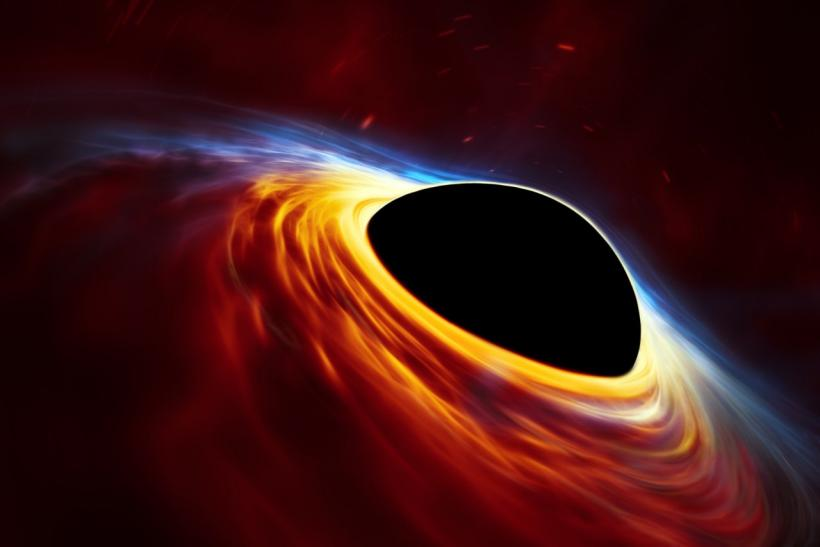
The Universe is merely a vast work of art consisting of tremendous mind-blowing entities, among which are Black Holes... And to keep things balanced, just like the Yin and the Yang, White Holes "might" exist too, mathematically proven but not yet observed.
So, what are Black Holes? How are they different from White Holes? Buckle up, since we're going to answer these questions in layman's terms, in this interesting article!
What are Black Holes?
We're pretty sure most of you have already heard of Black Holes, those mysterious dark monsters which absorb everything in their perimeter, so that even light cannot escape. But, what exactly are Black Holes?
To start, let's delve into some brief history first:
The initial hypothesis of the existence of Black Holes, or "Dark Stars" as how it was referenced back then, dates to the 18th century, when professor John Michell reasoned that, since light might be made of particles (based on Sir Isaac Newton's hypothesis), then a really massive star could have a gravity so strong that even light particles couldn't escape it, rendering the star invisible to astronomers, hence the name "Dark Stars". Few years later, French famous intellect Laplace independently described the same phenomena of massive stars absorbing light particles, calling such objects "Dark Bodies".
It wasn't however until 1915-1916, when Albert Einstein came up with his theory of General Relativity, and astronomer Karl Schwarzschild solved some tricky equations, that Black Holes started to get into mathematical forms, therefore real science. From there, many physicists and cosmologists, notably John Wheeler (who renamed Black Holes from "Frozen Stars") and Stephen Hawking, took Black Holes more seriously; and It wasn't until 55 years after the first mathematical solution, to be precise in 1971, that the first Black Hole was actually discovered.

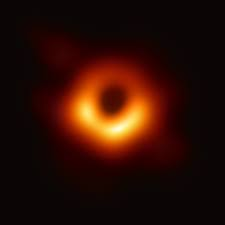
Finally, as you may have heard recently on the news, on April 10, 2019, the Event Horizon Telescope (EHT) rendered the very first image of a Black Hole, located at the center of Galaxy M87.
Enough history, let's dig deeper into more captivating stuff.
So, in brief, a Black Hole is a "monstrous mystery". Some scientists define it as a state of infinite density, a concept that our brain cannot clearly understand, while others refer to it as "a region where the fabric of space-time closes on itself". But the most simple and effective definition, away from physics and mathematics, describes a Black Hole as "a region in space where the gravitational field is so intense that light bends".
Things are starting to look interesting! But, how exactly are Black Holes formed?
Black Holes are the descendants of stars - supergiant red stars - 10 times more massive than our Sun, but whose lifespan represents only a fraction of the life of ordinary stars. In general, stars would resist their own massive gravities, by a combination of nuclear processes, until eventually they run out of fuel. These stars would collapse under their own gravity, causing them to either die in peace, or contract into an infinitesimal point of extremely large density, forming a Black Hole. So to elaborate a bit, when their life comes to an end, the gravitational collapse at the heart of those red supergiants raises the temperature to reach 100 of millions of Kelvins, causing helium and carbon to merge and form heavier elements like oxygen, silicon and sulfur. Then, the star implodes under the effect of its own weight and projects a shock wave, exploding into what is called a Supernova.

The residue consists of a super dense object of subatomic particles; and a neutron star (around 16 km in diameter) is formed, whose mass is one Million times greater than the mass of Planet Earth: That's the birth of our Black Hole.
Are Black Holes all the same?
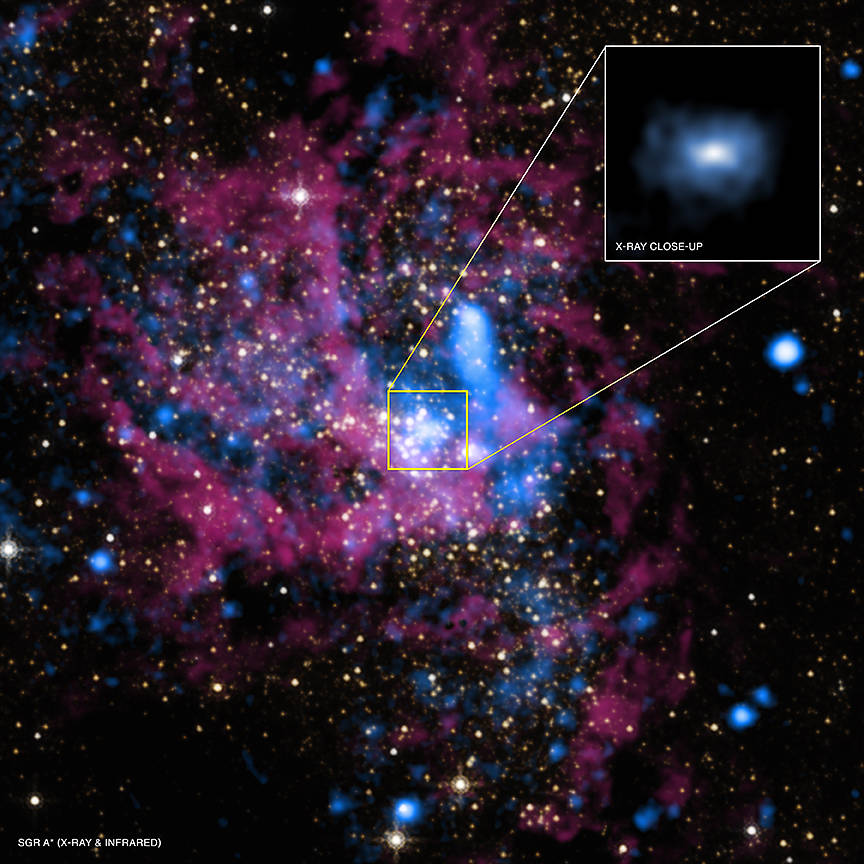
Technically, there are three types of Black Holes: stellar, supermassive and intermediate Black Holes. The most fascinating one is the supermassive, which is usually located at the center of nearly every Galaxy. These Black Holes are the result of the combination of several intermediate Black Holes. To anticipate your question, Yes, scientists were able to locate the Black Hole at the center of our Galaxy, the Milky Way, after several years of studies and research. In fact, they were first able to locate it before even seeing it, by studying the motion of stars at the center of the Galaxy, and were hence capable of guaranteeing its presence. If you're curious to know, they named it Sagittarius A*. During summer evenings, turn South and look at the track of the Milky Way near the constellation of Sagittarius… And this is Sagittarius A* for you.
But...why do Black Holes absorb everything and what makes them look Dark?
Think of a Black Hole as a massive amount of matter condensed into a small volume of space. This would result in a gravitational field so strong, which would attract everything in its perimeter, so that even light couldn't escape, knowing that light is made of small particles called Photons. Therefore, at a certain distance from Black Holes (Event Horizon), even particles travelling at the speed of light cannot escape the strong gravitational pull, making Black Holes look Dark.
Now that you learned about Black Holes, you might have already pictured how their counter-twin, White Holes, work, and we're sure what you're thinking of might be right!
So... What are White Holes?
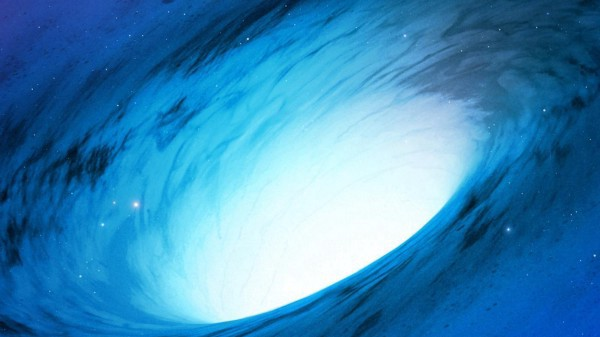
After a total comprehension of Black Holes, understanding White Holes becomes quite easy. But wait, not that easy after all! To start with, White Holes are the opposite of Black Holes. In simple terms, just as Black Holes absorb matter, White holes would emit matter. In fact, similarly to the Event Horizon of Black Holes, the point of no return, after which no matter can escape, and things start to accelerate faster than the speed of light (It's not exactly it since we're not in the same space-time reference anymore, but think of it that way); Event Horizons here are the barriers after which no matter can enter White Holes, since particles would require a speed faster than celerity to enter.
We know what you're thinking of! And here's the answer:
Where Black Holes are the entry door, White Holes could potentially be the exit! Didn't this concept remind you of the Big Bang Theory? In fact, the Big Bang Theory states that the Universe as we know it was created 13.8 Billion years ago by a fast expansion of a dense point in space, a singularity, where the whole matter consisting our Universe was sourced, and since then, the expansion has never stopped. That's why, speaking of pure theory now, there could be great similitude between the creation of White Holes and the Big Bang.
But before digging deeper into this mind-blowing theory, let's explain a bit how could White Holes possibly exist.
Being the second Schwarzschild's solution to Einstein's equations, White Holes could possibly suddenly come out of nowhere, spitting matter injected by one or more Black Holes. Keep this in mind since we'll get back to it in a minute.
Now, based on the aforementioned, our Universe could possibly be created by a White Hole and this is where it becomes crazy! According to Stephen Hawking, Black Holes emit constantly what is called Hawking Radiations. But as particles escape from a Black Hole, the latter would eventually shrink and disappear. Therefore, information that was sucked into the heart of those dark giants, and wasn't able to escape via radiation, is technically destroyed! This defies the laws of quantum physics, since no data can be destroyed, which created what is called an Information Paradox, debated in the scientific community until this day. Nevertheless, before he died, Hawking and other scientists were working on theories that might prove that data isn't lost, but rather stored somewhere on the horizon of Black Holes. But after discussing the concept of White Holes, one may predict that information isn't lost in Black Holes, instead, it's transmitted or transmuted to other random places in the Universe, or Multiverse, agreeing with both General Relativity and Quantum Mechanics principles, in a mind-blowing way!
You heard it right… If White Holes ever come to be proven, our Universe might not be the sole Universe after all. All of this is really astonishing but we have to be a little realistic since till now those super massive bodies are purely theoretical; and outside mathematical solutions they have never been observed to this very particular day. Nevertheless, in 2006, scientists observed a gamma-ray burst, an extremely energetic explosion that is caused by the death of a star, about 3000 Billions times the energy of our beloved Sun. But what was really perplexing is that the duration of this particular explosion was about 1 minute 42 seconds, while the duration of normal gamma-radiations is limited to a few seconds at maximum. Moreover, in the region where the explosion was observed, no stars died during that period, and that's what gave scientists some hope for the existence of White Holes.
Now, let's suppose White Holes actually exist.
According to the law of thermodynamics, our Universe is considered to be a control volume that is isolated, then it only interacts with itself, so how could we explain the presence of those theoretical White Holes? They should be connected somehow to one or more Black Holes, but how?
Wormholes (AKA Einstein-Rosen Bridge)
Wormholes are tunnels that connect two distant points in space, and these could be possible since the time-space fabric is not planar. For instance, imagine that the Universe's space is like a giant paper. This paper however is not planar, it's twisted and plied in a multidimensional manner. To create a wormhole in this paper Universe, all you have to do is induce a hole where the paper is plied, just like in the picture below:

Now, Wormholes happen to be only mathematics on paper too; still, if we were able to prove their existence, Wormholes could explain the connection between Black Holes and White Holes - setting aside the possibility of quantum-physical explanation related to singularities. The Wormholes that theoretically connect Black holes to White Holes could be considered to be a tunnel joining 2 different dimensions - maybe time independent - or 2 completely different (parallel) Universes! Hence, maybe we can travel across space-time, to the past, to the future, or maybe to a parallel present! Till our day, we still do not have enough knowledge and technology to refute time travel, so maybe it's not just science fiction after all. In the distant future, you could possibly see yourself make different decisions, at the same time, in multi-different dimensions or Universes.
What about Multiverses?
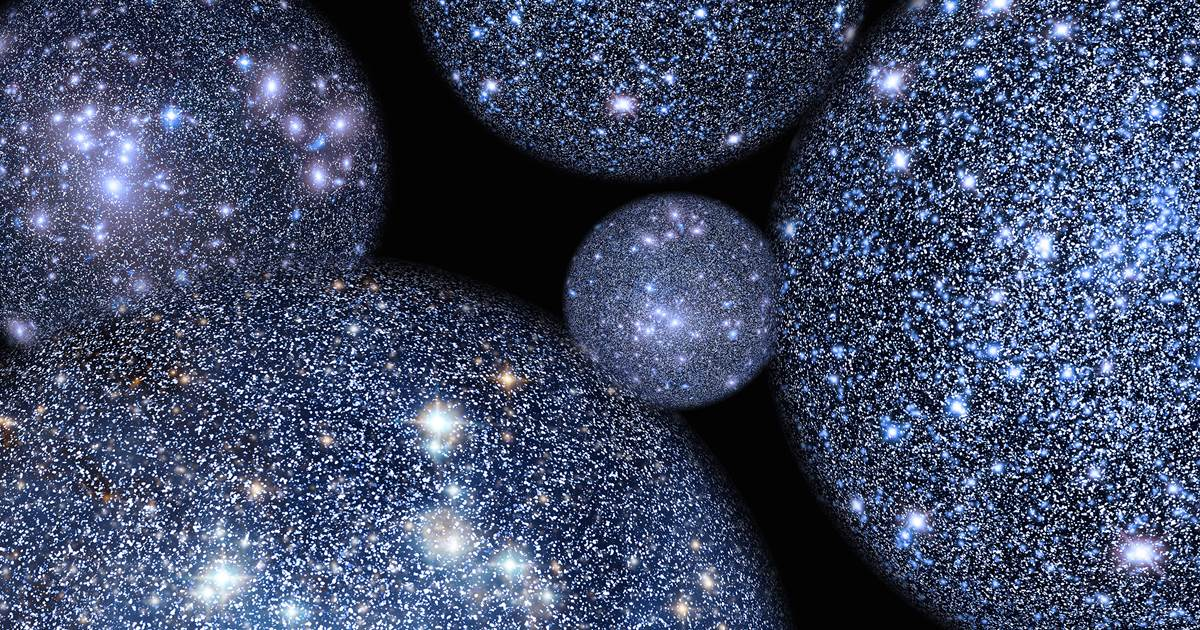
Heretofore, the concept of Multiverses was pure science fiction, with no serious possible explanation, but after tackling Black Holes, White Holes and Wormholes from our viewpoints, Multiverses inside our Universe - pocket Universes - or outside the radius of our Universe, might actually be possible. How come? In essence, every White Hole could possibly generate other Big Bangs, generating multiple Universes inside our own, or outside its radius or boundaries. Moreover, what if parallel Universes existed where quantum probability might be different than our Universe? Hence, the laws of physics there would be different, reality could be made from antimatter, or possibly time wouldn't be positive and unidirectional! Probably, these Universes would be mirrors to our Universe, with divergent timelines based on different quantum states coming to life, confirming quantum superposition.
There is absolutely no possible way to prove such theories in the near future, but it's good to bring it to serious questioning. In reality, past astronomers believed our Planet to be alone, then our Solar System to be unique, later others thought that our Galaxy is the sole existing one. And after finally proving the presence of multiple other planets (and hopefully habitable ones), stars, and Galaxies, then the existence of multiple Universes isn't a theory to dump.
But before letting you wander on your own, take a deep breath and try to stay calm, since what we'll end this article with might leave you tripping...
Our Universe might be an illusion...
The Milky-Way, Planet Earth, your cozy house and even Yourself may all be merely some sort of holograms. Lots of scientific proofs may align with this claim, like the fact that all matter is formed by fundamental particles (quarks, leptons, and so forth), or that the smallest length possible in the Universe is constant, and equal to Plank's constant: 1.6 x 10^-35 m, which was refuted by the String Theory (the possible sequel to this article). However, another intricate theory related to Black Holes consists of the dimension of reality. The actual information that we have regarding Black Holes suggest that our reality is a 2D reality. You heard it right. A 2D reality.
In the past, scientists used to think that when a body is absorbed by a Black Hole, the object in its 3D form is lost, but in reality, the process may be much more complex. Let us consider an example to make things a bit clearer:
Suppose Maria lost her purse, 1000 years from now, whilst on a commercial trip near the Event Horizon of a Black Hole. Although we said earlier that nothing can escape a Black Hole, things could possibly be more complicated: the purse - or its information - may not be totally lost. After several years of studies and research, mathematical equations describing Black Holes predicted that when a 3D object is absorbed by a Black Hole, a 2D copy of all its information is stored at the surface of the Black Hole, while the 3D form is absorbed. So in our case, a 2D copy of Maria's bag is stocked or projected on the Event Horizon of the Black Hole. Now, the purse would theoretically exist in 2 distinct places: inside the Black Hole, in its 3D form, and on its surface, as a 2D image. That's another hypothesis confirming that it may be possible to know what is inside a Black Hole by analyzing its surface information. Consequently, our Universe might be a Holographic one, or possibly a projection of another Universe inside a Black Hole; leaving us a species living in an illusion, in a vain constant pursuit of our true reality…
To conclude, here are few questions to guide you in your self-reflection session after this long read… Thank you for reaching this stage, and apologies for the mind-blowing explanations!
- Could Black Holes, White Holes, and The Multiverse Theory finally bring Religion (our Creator, Heaven, life after death... to list a few) and actual science in line? Or will these observations bring radical denial of long believed Religious concepts?
- With all the breakthrough and advancements in technology, and understanding of particle physics, quantum mechanics and the forces of the Universe, time travel could possibly take place in thousands of years from now. Suppose we manage to control the space-time fabric, how will Humans make use of this powerful tool? How harmful or useful could it be?
- Finally, do you think a Parallel Universe could exist, where an exact image of our reality is taking place? If so, you may take a break from work today, your other Self is doing the job for you…
"It takes me hours to craft minutes-worth of words which will hopefully inspire you for days, months or years!" - Elio Gereige
Comments